
Artist Operations
How Artist Managers Organize Multiple Artists Without Missing Deadlines
A portfolio view, standard stages, one owner and approver per deliverable, and a weekly exception review keep a growing artist roster on schedule.

Managing five artists is not five copies of managing one. The fix is not a bigger version of a solo-artist checklist — it's a shared portfolio view, one standard set of stages every release and show moves through, a named owner and a named approver on every critical deliverable, and a short weekly review that surfaces only what's late, blocked, or unowned.
Why five artists isn't five times one artist
A single-artist workflow tolerates a little mess: a mix deadline slips a few days, a show detail lives in a text thread, and nothing else breaks. Add a second, third, fourth, and fifth artist, and the same habits compound differently — the same mastering engineer is booked for two masters in the same week, a settlement follow-up for one artist gets missed because you were heads-down on another artist's release, and no single view shows which of the five deadlines is actually the most urgent.
PMI's guidance on project portfolio management makes the same point about running several projects at once: managing each one well is not the same skill as managing the set of them well. A portfolio view exists to align, prioritize, and balance across projects instead of reacting to whichever one is loudest that day. A roster is a portfolio — five artists, each with releases, shows, and money moving on a different clock, that all draw on the same manager, the same vendors, and the same cash. It's also the point where a spreadsheet-based setup built for one artist tends to strain: the records stop being easy to keep connected across five people at once.
Give every release and show the same stages, keep each artist's plan
Standardize the shape of the work, not the artist. Every release can move through the same named stages — for example: Planned → Locked → In Production → Ready → Live → Wrap-up — and every show through Inquiry → Confirmed → Advanced → Settled. The stage names stay identical across the roster; the dates, budgets, vendors, and creative decisions inside each stage stay specific to that artist.
This is what makes a cross-roster view possible at all. If one artist's tracker calls a stage "mixing" and another calls it "post-production," you can't scan five artists' work in one glance — you have to translate each one first.
Build one cross-roster deadline view and a short priority queue
With standardized stages in place, put every artist's next deadline, and the stage it belongs to, in one place — sorted by date, not by artist. That single view answers a question that is cumbersome to reconstruct from separate artist sheets: across the whole roster, right now, what's actually next?
From that view, pull a short priority queue — three to five items, not a restatement of every open task. PMI's portfolio guidance describes ranking candidate work against a small set of criteria instead of letting decisions get made by "whoever asks loudest." The roster version of that rule: the priority queue is set by deadline proximity and consequence of a miss, not by which artist called last.
Name one owner and one approver for every critical deliverable
Every deliverable that can stall a release or a show — a final master, an advance pack, a settlement review, an artwork sign-off — needs exactly one person responsible for doing it and exactly one person responsible for signing off on it. When a deliverable has no named owner, or when "approval" means anyone on the team might weigh in, it drifts. Naming both roles is a discipline you run yourself as the manager; it doesn't require special software, just a habit of writing the two names down next to the deliverable and refusing to let either field stay blank.
Track what your artists share, not just their separate plans
A roster shares resources that a single-artist workflow doesn't have to think about: the same engineer, publicist, or videographer working across two or more artists' calendars; one cash position funding several artists' expenses; your own attention split across all of them; and industry contacts — a booker, a playlist editor, a press contact — who hear from more than one of your artists.
Unflagged, these become the conflicts that actually cause missed deadlines: the same mixer double-booked for two masters due the same week, a promo window two artists both want, or a settlement paid out of a shared account without checking what else was due. Track these as roster-level records, not artist-by-artist notes, so a conflict is visible before it becomes a missed date.
Run a weekly roster review built on exceptions, not a status readout
Reading every task for every artist every week becomes less useful as the roster grows: the review gets longer, while the decisions that need attention get harder to spot. PRINCE2's management-by-exception guidance uses a related project-governance rule: teams work within an agreed range and escalate when work exceeds it. Applied to a roster, that means the weekly review looks at what's late, blocked, unowned, or over budget — not a recap of everything that's on track.
A workable 20–30 minute agenda:
- Exceptions first (10 min). Anything late, blocked, or missing an owner or approver, across all five artists.
- This week's cross-roster deadlines (5 min). Pull straight from the shared deadline view.
- Shared-resource conflicts (5 min). Vendor double-bookings, cash pinch points, contact overlaps.
- The roster's three priorities (5–10 min). The handful of things that most need to move this week, regardless of which artist they belong to.
A fictional five-artist week
The table below is a fictional operating template — not an MNGR product screenshot and not real client data — showing how overlapping deadlines look once they're standardized into one view. Download the five-artist priority diagram as an SVG, which also lays out the weekly review agenda below.
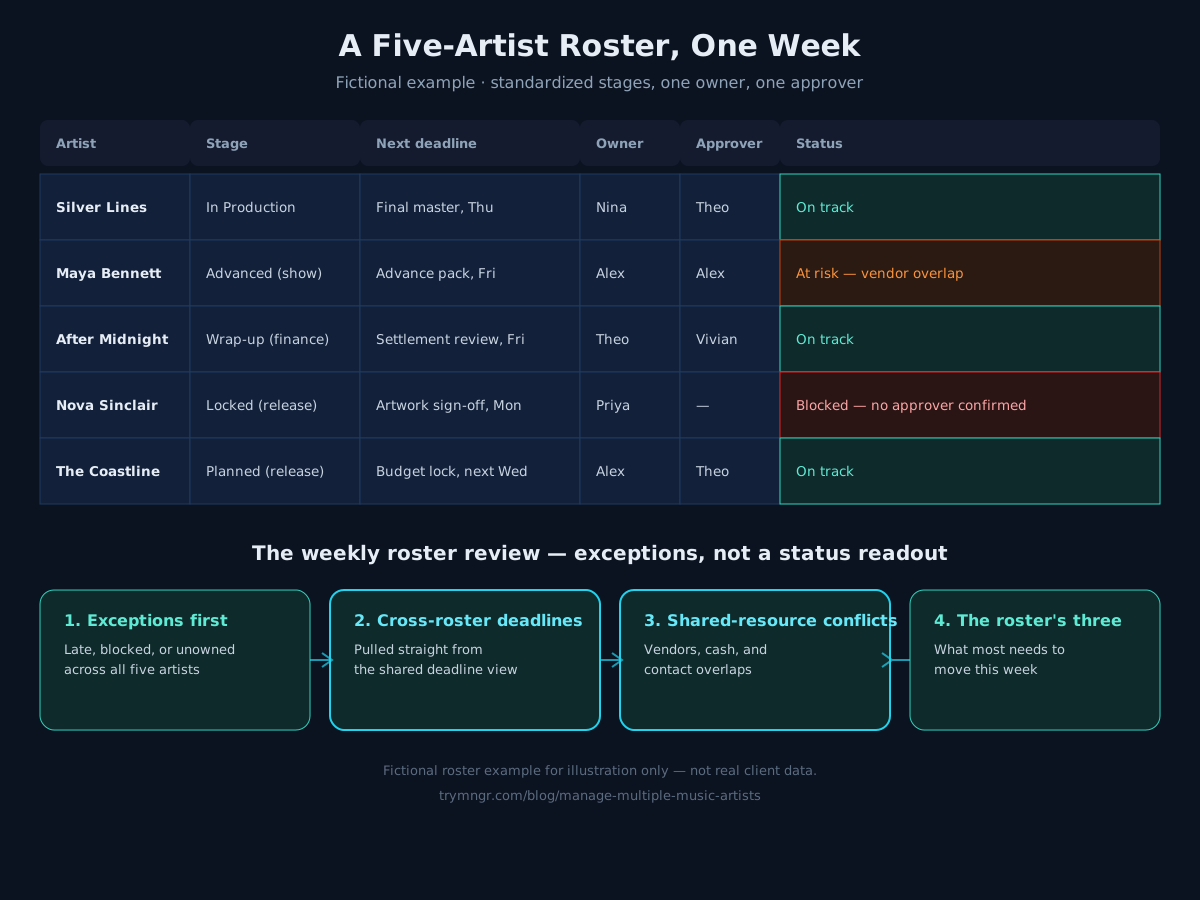
| Artist | Stage | Next deadline | Owner | Approver | Status |
|---|---|---|---|---|---|
| Silver Lines | In Production (mastering) | Final master due Thursday | Nina | Theo | On track |
| Maya Bennett | Advanced (show) | Venue advance pack due Friday | Alex | Alex | At risk — vendor overlap |
| After Midnight | Wrap-up (finance) | Settlement review due Friday | Theo | Vivian | On track |
| Nova Sinclair | Locked (release) | Metadata and artwork sign-off due Monday | Priya | Nina | Blocked — no approver confirmed |
| The Coastline | Planned (release) | Budget and dependency lock due next Wednesday | Alex | Theo | On track |
Two things stand out because the roster is in one view: Maya Bennett's advance pack carries a vendor-overlap risk, and Nova Sinclair's sign-off has no confirmed approver — exactly the kind of gap a weekly exception review exists to catch before it becomes a missed date.
Where this breaks down
- Copying single-artist habits five times. A solo-artist weekly system run five separate times, once per artist, recreates the same blind spots a shared roster view is meant to remove.
- No named approver. "The team will review it" is not an approver. Deliverables stall in an ambiguous waiting state until one person is named.
- A review that reads every task. Once the agenda stops being exception-based, it grows with the roster until people stop attending prepared.
- Shared-resource conflicts caught too late. A vendor, cash, or contact conflict is cheap to catch in a Monday review and expensive to catch on the deadline itself.
How MNGR supports this, and where it stops
MNGR's shared workspace gives a manager cross-roster dashboard counts for artists, releases, shows, and tasks, plus near-term release, show, and task pressure in one scan. The task list can be sorted by due date and filtered by artist or assignee; each task can carry one assignee and one due date. Shows, contact interactions, calendar entries, and finance records can stay linked to the artist they belong to. Together, those implemented views support the weekly exception pass described above, although the fictional five-artist table is an operating template rather than a literal MNGR screen. MNGR's Manager plan currently covers up to five artist profiles and three team seats for $49 per month; the Label plan covers up to 20 artist profiles and unlimited team seats for $99 per month.
MNGR is not yet a label-scale system for formal approval workflows, granular permissions, private views, or asset versioning. The "owner and approver" discipline above is a naming convention you run as the manager — MNGR tracks who owns a task and its due date, but naming and enforcing an approver is still your call, not a permissions feature. If your team needs a formal sign-off chain with restricted visibility, verify that need against your actual plan before assuming it's covered.
Sources: PMI, "Project Portfolio Management: How to Do the Right Projects at the Right Time"; PRINCE2, "Balancing Control, Speed, and Risk". Reviewed and current as of July 2026.
Sources
Continue the workflow

A Weekly Artist Management Meeting Agenda That Keeps Work Moving
A copyable 30-minute weekly meeting agenda for artist managers, built around decisions, owners, due dates, and exceptions across releases, shows, and finance.
Read article
The Independent Artist Operating System: A Simple Weekly Workflow for Running Your Music Career
A one-page operating system for independent artists: eight layers, one 30-minute weekly review, and a daily touch that keeps releases, shows, and money moving.
Read article
Music Release Checklist: From Final Master to 30 Days After Release
A copyable release checklist grouped by time window, with an owner, dependency, status, and evidence field for every task from final master to day 30.
Read article